Why Good Real Estate Projects Get Stuck
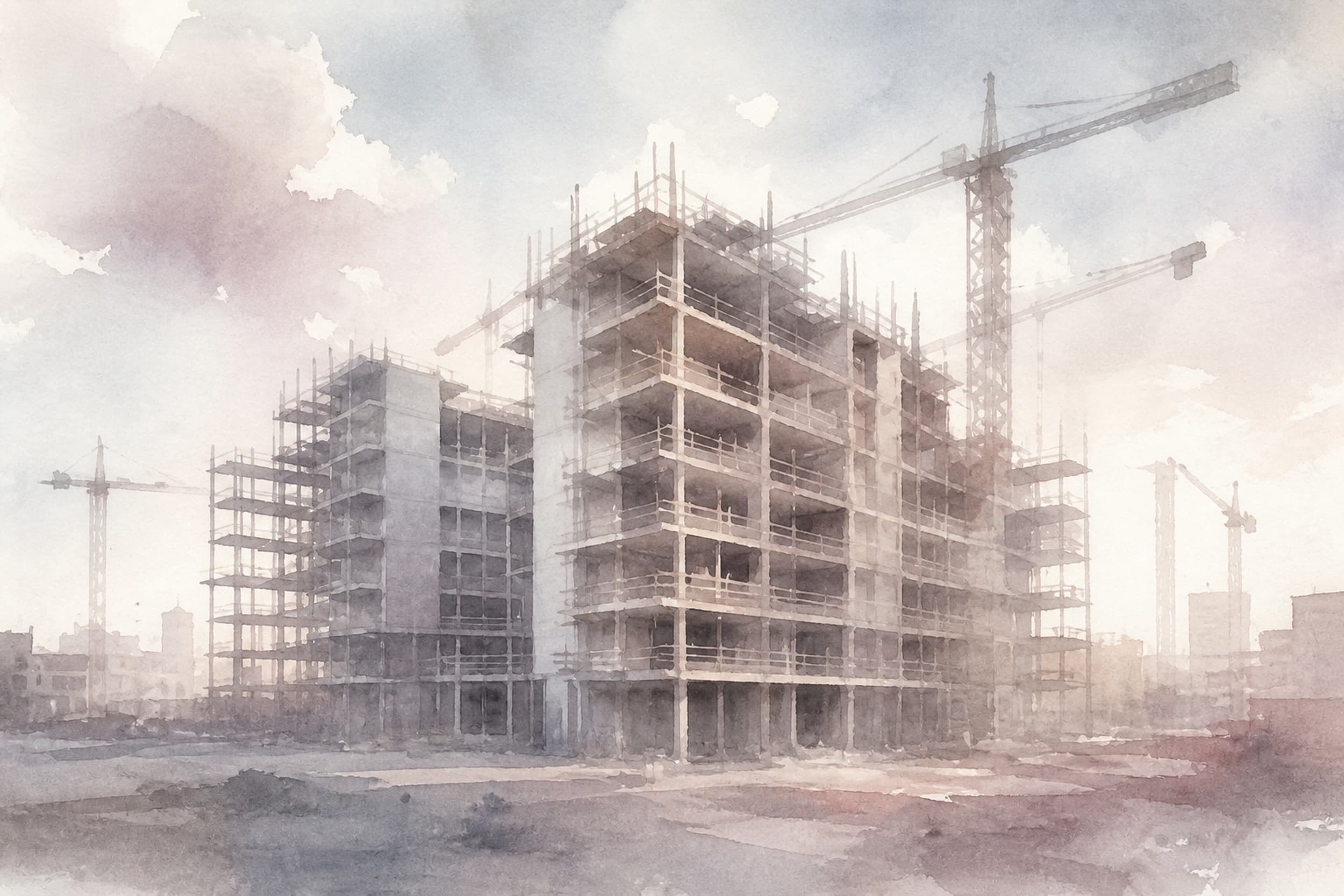
A strong location, capable team and real market demand are not always enough. Projects get stuck when yesterday's assumptions continue to drive today's decisions.
By the time a real estate project is described as "stuck," financing is usually the most visible problem.
The construction loan is no longer sufficient. New equity is difficult to justify. Carrying costs continue while the expected completion date moves further away.
But financing is often the last symptom, not the first cause.
The real problem may have started much earlier—with a product designed for a market that has changed, a budget based on an earlier version of the building or a capital structure that leaves no room for delay.
None of these issues exists in isolation. That is what makes complex projects difficult to resolve.
The plan belongs to a market that no longer exists
Real estate moves slowly. Markets do not.
A project conceived several years ago may reach construction under entirely different conditions. Interest rates change. Costs rise. Buyer and tenant expectations evolve. Competing supply enters the market.
The original business plan can still look coherent on paper while becoming increasingly disconnected from reality.
This is where sunk cost becomes dangerous. A team may continue advancing a product because it has already been designed, entitled or financed—not because it remains the best use of the asset.
Progress is confused with commitment to the existing plan.
A better response begins by separating the value of the asset from the assumptions attached to it. The location may still be strong. The entitlement may still be valuable. The project may still meet a genuine market need.
But the product, phasing, design or use may need to change.
The objective is not to recover the original plan. It is to identify the plan that works now.
More capital does not always solve the problem
Additional capital can save a project. It can also preserve the wrong plan.
When a project faces a funding gap, the immediate question is often where new money will come from. The more important question is what the new money will accomplish.
If it provides time to complete a viable project, the answer may be clear. If it simply supports outdated assumptions, the same problem is likely to return—only with more capital at risk.
Before introducing new money, the project needs to be re-underwritten from the present.
That means revisiting revenue, cost, timing and exit assumptions without trying to defend the original model. It also means testing whether the capital structure still matches the project's duration and risk.
A long, complex repositioning cannot be supported comfortably by capital that depends on a short and predictable timeline. Excessive leverage can remove the flexibility needed to make good decisions. New equity may fill a gap without changing the conditions that created it.
Capital matters. But capital is most effective when it supports a credible operating and delivery plan.
Cost is designed before it is priced
Construction cost is often treated as something discovered through bidding.
By then, much of it has already been determined.
Cost is embedded in the building's geometry, structural system, façade, mechanical design, unit repetition, material choices and construction sequence. Procurement may confirm the number, but design creates much of the underlying obligation.
This is why conventional value engineering often disappoints. It begins too late and focuses on removing visible scope rather than reconsidering how the project should be built.
The result may be a less competitive product without a fundamentally better delivery strategy.
Design, procurement and construction need to inform one another earlier. Greater repetition, simpler systems, different sourcing strategies and prefabricated or modular components can improve the relationship between cost, quality and schedule.
The goal is not simply to make the project cheaper.
It is to make the project more buildable and the outcome more certain.
Schedule risk is often decision risk
Project schedules are built around activities: design, permitting, procurement, construction and turnover.
What they often fail to show is the time consumed by unresolved decisions.
The design team may be waiting for updated pricing. Pricing may depend on drawings that cannot be completed until the product is confirmed. A lender may be waiting for a revised business plan. The business plan may depend on a schedule that cannot be finalized until the design is resolved.
Everyone is working, but the project is not moving.
This kind of delay compounds quickly. Interest and carrying costs continue. Pricing becomes less reliable. Consultants and contractors lose continuity. Market conditions change again. Stakeholders become more cautious at the moment when the project most needs clear and timely decisions.
The critical path is therefore not always a construction activity.
It may be a sequence of financial, design and governance decisions: who can authorize a change, what information they require, which stakeholder must agree first and what happens if no decision is made.
Updating the construction schedule will not resolve that problem.
The project needs a decision schedule—one that identifies the decisions holding up multiple workstreams, assigns a clear owner and defines the minimum information required to move forward.
Speed does not come from making every decision quickly. It comes from resolving the few decisions that allow many others to proceed.
Everyone can be doing their job while the project fails
Real estate projects depend on specialized participants.
Architects protect design intent and regulatory compliance. Contractors focus on cost, constructability and schedule. Lenders manage credit exposure. Investors evaluate risk and return. Operators consider the asset's long-term performance.
Each participant can make a reasonable decision within their own area while the project as a whole moves in the wrong direction.
A design decision may improve the building but undermine the budget. A financing condition may protect the lender while reducing the flexibility needed to complete the work. A cost reduction may help construction but weaken the product's market position.
The problem lies between the disciplines.
Complex projects need someone to connect the financial model, the building, the stakeholders and the execution plan. Without that integrated view, information moves between teams but judgment remains fragmented.
The most important decisions are usually the ones that affect several parts of the project at once.
A change in product mix may alter revenue, design, approvals and construction cost. A different building system may affect schedule, procurement, financing and quality. A revised capital structure may create the time needed to make better physical decisions.
These decisions cannot be made effectively from only one perspective.
Under pressure, stakeholders protect position before value
When a project performs as expected, stakeholder interests are easier to align.
When it does not, each party begins by protecting its downside.
The lender focuses on collateral, repayment and limiting further exposure. Existing equity questions whether another dollar can be justified. The sponsor tries to preserve ownership and control. Contractors and consultants seek payment before committing additional resources.
Each response may be rational on its own.
Together, they can leave the project unable to make the decisions required to preserve value.
This is why a technically viable business plan may still fail. The economics may work at the project level while remaining unacceptable at the stakeholder level.
A restructuring must answer more than whether the revised project can create value. It must also address who contributes the next dollar, who bears the first loss, who controls the major decisions and how any future upside will be shared.
New capital may require priority or additional protection. Existing stakeholders may need to accept dilution, revised control or a different return profile. Lenders may need to exchange immediate enforcement rights for a more credible path to repayment.
Alignment does not mean that every participant receives the outcome they originally expected.
It means that each essential participant has a rational reason to support the revised plan—and that moving forward creates more value than continuing to protect a position in a stalled project.
Moving forward requires a reset
A stuck project does not need another version of the same plan. It needs a clear assessment of what remains valuable, what has changed and which assumptions should no longer be protected.
Some constraints are real: entitlement, structural conditions, contractual obligations or limited capital. Others exist because the project has always been approached in a particular way.
The first task is to tell the difference.
From there, the work becomes more focused:
- Re-underwrite the project using current conditions.
- Identify the few decisions capable of changing several outcomes.
- Align the capital structure with a realistic path to execution.
- Connect design decisions directly to market position, cost and delivery.
- Give stakeholders a reason to support the revised plan.
Not every project can or should be rescued. Sometimes the right decision is to stop, sell or accept a different outcome.
That judgment is also part of doing the work well.
Complexity is not automatically a source of value. It becomes an opportunity only when the project can be understood as a whole—and when the team is willing to replace inherited assumptions with decisions that work in the present.
Stuck projects are not always broken assets.
Often, they are good assets carrying the wrong plan.